
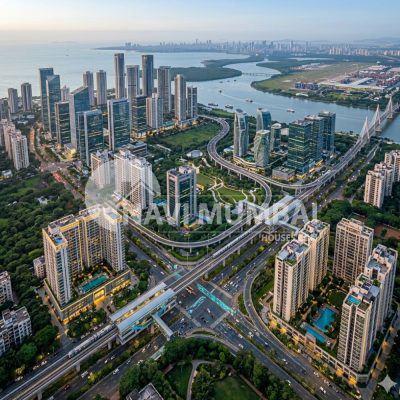
Navi Mumbai property trends in 2026 are showing strong momentum as infrastructure growth, rising demand, and improving connectivity continue transforming the market.
Today, however, the city is rapidly becoming one of the most active real estate destinations in the Mumbai Metropolitan Region. Property prices are climbing steadily, infrastructure projects are finally transforming connectivity, and investor confidence is returning with strong momentum.
More importantly, serious homebuyers are no longer waiting on the sidelines.
Families who once searched for homes in Mumbai are now shifting their attention toward Navi Mumbai because they want larger spaces, better planning, cleaner surroundings, and stronger long-term value. At the same time, investors are aggressively entering strategic locations before the next major appreciation cycle begins.
Consequently, June 2026 has become a defining moment for the market.
The Navi Mumbai real estate market is entering one of its strongest growth phases in 2026, attracting both serious investors and long-term homebuyers.
If you are planning to invest, upgrade your lifestyle, or secure a future-ready home, this report will help you understand where Navi Mumbai stands today—and where it could head next.
Navi Mumbai Property Trends Overview – June 2026
Over the last 18 months, the Navi Mumbai property market has shown consistent and healthy growth. Unlike earlier speculative cycles, today’s market is being driven by genuine end-users, infrastructure execution, and rising commercial activity.
Furthermore, several large-scale developments are reshaping the city’s future:
- Mumbai Trans Harbour Link
- Navi Mumbai International Airport
- Navi Mumbai Metro expansion
- Improved railway and road connectivity
- Commercial growth in Airoli, Ghansoli, and Belapur
As a result, buyer sentiment has become significantly stronger compared to previous years.
Earlier, people questioned whether Navi Mumbai had long-term growth potential. Today, however, the discussion has shifted toward identifying which micro-markets still offer maximum upside.
That transition is extremely important because once a city gains widespread confidence, property prices often accelerate rapidly.
Furthermore, housing market trends from MahaRERA indicate increasing buyer activity across several Navi Mumbai nodes.

Navi Mumbai Property Trends and Price Growth in 2026
Property values across Navi Mumbai have continued their upward trajectory in 2026. At the same time, buyer confidence has also improved significantly due to ongoing infrastructure execution and rising commercial activity.
Average Residential Price Range – June 2026
| Location | Approx. Price Range |
|---|---|
| Kharghar | ₹15,000–₹21,000/sq.ft |
| Ulwe | ₹11,000–₹16,000/sq.ft |
| Panvel | ₹9,000–₹14,000/sq.ft |
| Taloja | ₹7,000–₹10,500/sq.ft |
| Seawoods | ₹24,000–₹36,000/sq.ft |
| Airoli | ₹22,000–₹34,000/sq.ft |
Interestingly, the strongest appreciation is happening in locations connected to upcoming infrastructure corridors and employment zones.
Moreover, buyers are increasingly prioritizing:
- Metro accessibility
- Airport connectivity
- Reputed developers
- Lifestyle infrastructure
- Rental demand potential
Because of this, quality projects are witnessing faster sales velocity compared to ordinary developments.
Why Investors Are Bullish on Navi Mumbai Property Trends
1. Infrastructure Is Finally Creating Real Impact
For years, Navi Mumbai’s growth story revolved around promises. However, 2026 feels different because infrastructure is now delivering visible results on the ground.
The operational success of the Mumbai Trans Harbour Link has dramatically improved travel convenience between Mumbai and Navi Mumbai. Consequently, commute-related hesitation among buyers has reduced significantly.
Meanwhile, the upcoming Navi Mumbai International Airport continues to attract both developers and investors toward nearby growth corridors.
Additionally, metro connectivity is improving internal travel across multiple nodes. As a result, previously overlooked locations are now entering serious investor discussions.
Of course, infrastructure alone does not guarantee appreciation. However, when infrastructure development is supported by employment growth, better livability, and improved connectivity, long-term property appreciation becomes far more sustainable.
That exact combination is now emerging across Navi Mumbai.
According to data from the CIDCO, multiple infrastructure projects are expected to accelerate long-term growth across Navi Mumbai.
2. Rental Demand Is Strengthening Rapidly
Another major shift in 2026 is the sharp improvement in rental demand. Moreover, several commercial hubs are now creating stronger housing demand from professionals and corporate employees.
Locations such as:
- Airoli
- Ghansoli
- Kharghar
- Seawoods
are witnessing strong demand from IT professionals, corporate employees, startup founders, and working families.
Consequently, rental yields have become more attractive than before. In addition, improving occupancy levels are further strengthening investor confidence across several micro-markets.
Estimated Gross Rental Yield – June 2026
- Airoli/Ghansoli: 3.5%–5%
- Kharghar: 2.8%–4%
- Ulwe: 2.5%–3.5%
More importantly, increasing office activity is expected to strengthen rental absorption further over the next few years.
3. Mumbai’s Affordability Crisis Is Benefiting Navi Mumbai
One of the biggest reasons behind Navi Mumbai’s growth is simple: Mumbai has become financially difficult for many families. As a result, homebuyers are now actively exploring locations that offer better lifestyle value without completely stretching their finances.
Today, buyers are comparing value more carefully than ever before.
For example, a ₹2.5–3 crore budget in Mumbai often forces buyers to compromise on:
- Carpet area
- Amenities
- Parking
- Open spaces
- Lifestyle quality
In contrast, the same budget in Navi Mumbai can secure:
- Larger homes
- Modern townships
- Better planning
- Improved lifestyle infrastructure
- Lower-density living
Therefore, many families now see Navi Mumbai as a practical upgrade rather than a compromise.
That emotional and financial shift is fueling sustained housing demand.
Best Locations Driving Navi Mumbai Property Trends
Kharghar – The Balanced Growth Market
Kharghar continues to remain one of the most dependable real estate destinations in Navi Mumbai.
The location offers a balanced combination of:
- Connectivity
- Educational institutions
- Metro accessibility
- Lifestyle infrastructure
- Long-term investment potential
Furthermore, Kharghar attracts both end-users and investors, which helps maintain strong resale liquidity.
Although prices have already appreciated considerably, the node still holds long-term premium growth potential because demand quality remains exceptionally strong.
You can also explore our detailed guide on Vashi vs Nerul vs Kharghar property investment comparison.
Ulwe – The Airport Growth Story
Ulwe remains one of the most discussed investment markets in 2026.
Naturally, airport-driven expectations continue to influence buyer psychology. However, smart investors are becoming far more selective than before.
Today, success in Ulwe depends heavily on:
- Project location
- Builder reputation
- Possession timelines
- Connectivity access
- Infrastructure proximity
As a result, reputed projects are appreciating strongly while weaker developments are struggling to maintain momentum.
Therefore, research has become absolutely critical in this market.
Updates related to the Navi Mumbai International Airport
Panvel – The Long-Term Infrastructure Bet
Panvel is steadily transforming into one of the most strategic growth corridors within the MMR region.
Unlike saturated urban pockets, Panvel still offers large-scale development opportunities.
Additionally, buyers are attracted by:
- Township projects
- Better future scalability
- Lower entry prices
- Long-term infrastructure integration
Because of this, long-term investors continue to view Panvel as one of the strongest appreciation plays for the next decade.
Airoli & Ghansoli – The Professional Rental Hubs
Airoli and Ghansoli are benefiting massively from commercial and IT expansion.
Consequently, these locations are witnessing strong demand from:
- Corporate professionals
- IT employees
- Senior executives
- High-income tenants
Although entry prices are relatively higher, these markets continue to offer:
- Better rental consistency
- Strong occupancy levels
- Quality tenant profiles
- Strong resale demand
Therefore, conservative investors seeking dependable returns still prefer these micro-markets.
Risks Buyers Should Not Ignore in 2026
Despite strong optimism, buyers should remain cautious about certain risks.
Oversupply in Select Areas
Some micro-markets continue to experience excessive project launches. Consequently, not every project will generate meaningful appreciation.
Therefore, buyers should carefully avoid:
- Weak developers
- Unrealistic pricing strategies
- Poorly connected projects
- Delayed possession risks
Instead, focusing on reputed builders can significantly improve long-term investment safety.
Builder Reputation Matters More Than Ever
In 2026, buyers are far more informed compared to previous cycles.
Today, projects from reputed developers are commanding:
- Faster sales
- Better resale premiums
- Higher trust levels
- Stronger appreciation potential
Meanwhile, unreliable builders are struggling despite operating in good locations.
Therefore, choosing the right developer has become just as important as choosing the right location.
Why Navi Mumbai Feels Emotionally Different Today
Beyond investment potential, there is another important reason why buyers are increasingly drawn toward Navi Mumbai—it simply feels more livable. Compared to overcrowded urban zones, the city offers a noticeably more balanced lifestyle experience.
Unlike overcrowded urban clusters, many parts of Navi Mumbai still offer:
- Wider roads
- Cleaner surroundings
- Organized infrastructure
- Open spaces
- Better urban planning
As a result, families experience a noticeably different lifestyle quality.
Parents prefer healthier environments for children. Working professionals want reduced commute stress. Investors seek future-ready infrastructure. Retirees, meanwhile, prioritize peaceful living.
Interestingly, Navi Mumbai now appeals to all four categories simultaneously.
That emotional connection is becoming a powerful demand driver.
Navi Mumbai Property Trends Outlook for 2026-2030
The next four years could become one of the strongest growth phases in Navi Mumbai’s real estate history.
Several major trends support this outlook.
Airport-Led Economic Expansion
Once airport operations scale further, the surrounding regions are expected to witness:
- Hospitality growth
- Commercial expansion
- Logistics demand
- Employment generation
Consequently, residential demand could rise sharply across connected nodes.
Premium Housing Demand Will Increase
As Mumbai’s affordability pressure intensifies, premium buyers are increasingly shifting toward Navi Mumbai for upgraded lifestyles.
Therefore, luxury and premium housing demand is expected to strengthen steadily.
Infrastructure Maturity Could Trigger Another Price Cycle
As metro connectivity and airport infrastructure mature, multiple locations could experience another wave of price appreciation.
Historically, infrastructure completion often acts as a major catalyst for real estate growth.

Final Verdict – Is June 2026 the Right Time to Buy?
For long-term investors and serious homebuyers, June 2026 appears to be a strategically important entry window.
However, success will depend on making informed decisions.
The strongest opportunities are likely to emerge from:
- Reputed developers
- Infrastructure-linked locations
- Transit-oriented projects
- High-demand micro-markets
More importantly, Navi Mumbai is no longer operating on future promises alone. The city is now entering a real execution-driven growth phase.
That distinction changes everything.
For buyers, this could be the right time to secure lifestyle quality before affordability narrows further.
For investors, meanwhile, the current market still offers opportunities before the next infrastructure-driven appreciation cycle becomes fully priced in.
In real estate, the biggest gains rarely happen after the crowd arrives.
They happen just before the transformation becomes obvious to everyone.
And right now, Navi Mumbai appears to be standing exactly at that point.
The post Navi Mumbai Property Trends 2026 appeared first on .