


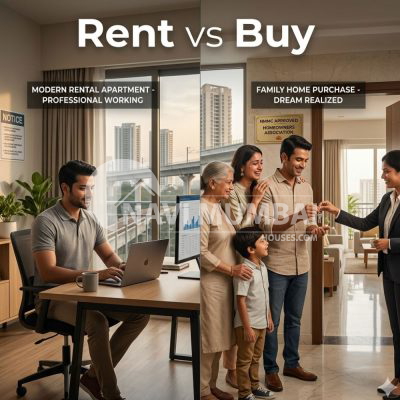
The debate around Rent vs Buy Navi Mumbai has become more important than ever in 2026. Rising property prices, increasing rents, and massive infrastructure growth are forcing homebuyers, investors, and working professionals to rethink one major financial decision: Should you continue renting or finally buy a home in Navi Mumbai?
For years, buying a house was considered the ultimate life goal. However, today’s market realities are changing that mindset rapidly.
Young professionals are choosing flexibility through renting, while families and investors are rushing to secure homes before prices rise further. At the same time, long-term renters are beginning to question whether they are building someone else’s wealth instead of their own.
The Rent vs Buy Navi Mumbai debate is becoming more important as property prices and rental demand continue rising in 2026.
Why the Renting vs Buying Debate Has Changed in 2026
A few years ago, renting was considered temporary and buying was seen as permanent success. Now, the situation has become far more strategic.
Massive infrastructure upgrades are reshaping Navi Mumbai’s future, including:
- The Navi Mumbai International Airport
- Metro connectivity expansion
- Mumbai Trans Harbour Link influence
- Commercial growth in Panvel, Ulwe, and Kharghar
Because of these developments, areas once considered “far” are now emerging as high-potential investment zones.
Consequently, property demand has increased steadily across several nodes. At the same time, rental demand has also surged because professionals want better connectivity without immediately committing to ownership.
This changing landscape has made the rent-versus-buy decision more complex — and far more important.
Understanding Navi Mumbai’s Real Estate Market in 2026
Unlike many overcrowded parts of Mumbai, Navi Mumbai still offers:
- Better urban planning
- Wider roads
- More open spaces
- Modern infrastructure
- Relatively larger homes
Due to these advantages, both buyers and renters are actively targeting Navi Mumbai.
Nevertheless, affordability is slowly tightening.
The Navi Mumbai property market is witnessing strong demand because buyers believe infrastructure growth will push prices even higher over the next few years.
For instance, premium micro-markets such as Nerul, Seawoods, and Palm Beach Road have witnessed significant appreciation in recent years. Meanwhile, developing locations like Ulwe and Panvel are attracting first-time buyers and investors looking for future growth potential.
On the rental side, prices have also increased noticeably.
A 2 BHK apartment that once rented for ₹22,000–₹25,000 now often commands ₹35,000 or more in several prime locations.
Naturally, many residents are questioning whether continuing to rent still makes long-term financial sense.
When Renting Makes More Sense in 2026
Despite the growing buying trend, renting can still be the smarter option in several situations.
1. If You Need Flexibility
When your career is still evolving, renting provides freedom that ownership cannot.
For example, renting may suit you better if:
- Frequent job changes are part of your career path
- Relocation could happen within the next few years
- Remote work gives you location flexibility
- Your income is still steadily growing
Additionally, renting reduces financial pressure because you avoid:
- Heavy down payments
- Long-term EMIs
- Property taxes
- Maintenance responsibilities
As a result, you can maintain better liquidity and adapt quickly to career opportunities.
2. If You Want a Premium Lifestyle Without a Massive EMI
Across Navi Mumbai, many residents currently rent homes in prime areas they cannot comfortably afford to purchase.
Locations like:
- Seawoods
- Vashi
- Nerul
- Palm Beach Road
…offer exceptional lifestyle advantages. However, purchasing property there often requires a very high budget.
By choosing to rent, you gain access to:
- Better schools
- Superior connectivity
- Lifestyle amenities
- Premium social environments
Meanwhile, your capital remains available for investments or business growth.
According to data from the Maharashtra RERA, infrastructure-led regions continue attracting strong buyer interest.
3. If You Are Investing Aggressively Elsewhere
A financially disciplined renter can sometimes outperform a buyer.
Here’s why:
- Renting requires lower upfront costs
- Investments remain flexible
- Capital can be diversified into multiple assets
For instance, if your potential EMI is ₹70,000 but your rent is ₹35,000, investing the remaining amount consistently into mutual funds or businesses could generate strong long-term returns.
However, this strategy only works if you genuinely invest the difference regularly.
Unfortunately, most people end up spending that extra money instead.
When Buying Makes More Sense in 2026
Although renting offers flexibility, buying is becoming increasingly attractive in Navi Mumbai’s growth cycle.
1. Infrastructure Growth Is Driving Appreciation
Infrastructure has always been one of the strongest drivers of real estate value.
In Navi Mumbai, projects connected to:
- Airport influence zones
- Metro routes
- Commercial hubs
- Major highways
…are expected to witness long-term appreciation.
For long-term investors, Navi Mumbai property continues to attract attention due to improving connectivity and future appreciation potential.For many working professionals, the Rent vs Buy Navi Mumbai decision now depends on long-term financial goals rather than emotions alone.
Historically, property prices rise gradually at first and then accelerate once infrastructure becomes operational.
Because of this pattern, many buyers now prefer entering the market early rather than waiting for “perfect timing.”
2. Rising Rents Are Becoming Financially Draining
Renting may feel affordable initially. Nevertheless, long-term rent outflows can become substantial.
Unlike an EMI:
- Rent never ends
- Ownership is never created
- Annual increases continue indefinitely
Consequently, many families now prefer converting monthly housing expenses into long-term asset creation.
Additionally, ownership offers emotional stability that renting often cannot provide.
3. Buying Early Can Protect Future Affordability
One major mistake buyers make is waiting endlessly for prices to fall.
In reality, rapidly developing cities rarely become cheaper over time.
Across several Navi Mumbai locations:
- Property values have risen faster than salaries
- Quality inventory has reduced
- Demand has increased due to infrastructure development
Therefore, delaying decisions can sometimes push buyers into even higher budgets later.
The Emotional Side of the Decision
Financial calculations matter. However, emotions also play a major role in real estate decisions.
A rented apartment may feel comfortable, but it rarely feels fully permanent.
Over time, repeated shifting, rent hikes, and owner restrictions can become mentally exhausting.
On the other hand, ownership creates:
- Stability
- Security
- Emotional comfort
- A stronger sense of belonging
Still, buying beyond your financial capacity can create stress instead of happiness.
That’s why the smartest decision balances ambition with sustainability.
Common Mistakes People Make
Mistake Renters Often Make
Many renters keep postponing ownership while waiting for prices to become affordable.
Unfortunately, in infrastructure-driven markets like Navi Mumbai, waiting often widens the affordability gap instead.
Mistake Buyers Often Make
Some buyers become emotionally pressured into purchasing homes they cannot comfortably afford.
As a result, they struggle with:
- Financial stress
- Reduced savings
- Lifestyle compromises
- Lack of emergency funds
A home should improve your quality of life — not reduce your financial peace.
So, What Actually Makes More Sense in 2026?
The answer depends entirely on your life stage, income stability, and long-term goals.
Renting Makes More Sense If:
- Flexibility matters more than long-term commitment
- Your career path is still evolving
- Relocation may happen within the next few years
- Investments and business growth are your current priorities
- Lower monthly financial pressure feels more comfortable right now
Buying Makes More Sense If:
- Long-term stability is a major goal
- A predictable income stream already exists
- Building wealth through property feels important
- Future-growth corridors attract your investment mindset
- Emotional security and ownership matter to your family
The Smart Hybrid Strategy Many People Are Using
Interestingly, many financially aware individuals are now combining both approaches.
In real estate, success rarely comes from timing alone.
Instead, long-term gains usually belong to people who understand where the city is heading before the broader market reacts.
Because of this balanced approach, areas like Panvel and Ulwe are seeing increased investor interest from people currently living in central Navi Mumbai.

Final Verdict: Renting vs Buying in Navi Mumbai in 2026
There is no single answer that fits everyone.
However, one thing is certain:
Making this decision blindly can become expensive later.
Navi Mumbai is entering a transformational phase driven by infrastructure, connectivity, and long-term urban growth.
As a result, both renters and buyers must think strategically rather than emotionally.
Whether you choose renting or ownership, understanding the direction of the Navi Mumbai property market is essential before making a financial commitment in 2026.
Ultimately, the right Rent vs Buy Navi Mumbai strategy depends on your income stability, lifestyle priorities, and future investment vision.
On the other hand, if you are financially stable and planning long-term, buying early in a growth corridor could become one of the smartest wealth-building decisions of this decade.
Because in real estate, timing alone does not create success.
Understanding where the city is heading before everyone else does — that’s where the real advantage begins.
If you are still researching high-growth investment zones, read our detailed guide on Navi Mumbai Property Trends 2026.
The post Navi Mumbai Property Guide: Renting vs Buying in 2026 appeared first on .