


Maharashtra rental deposit rules are something every tenant should understand before signing a rental agreement. Imagine finding the perfect apartment in Mumbai, Navi Mumbai, Pune, or Thane, only to face disputes over your security deposit when it’s time to move out. Many tenants unknowingly lose money because they don’t fully understand how rental deposits, deductions, and refund timelines work in Maharashtra.
The landlord asks for ₹1 lakh, ₹2 lakh, or even more as a security deposit. You pay it because it seems like a standard requirement. However, months or years later, recovering that money may not be as straightforward as expected.
Security deposits are designed to protect landlords against damages, unpaid rent, or breaches of agreement. At the same time, tenants need protection against unfair deductions and delayed refunds. Therefore, understanding Maharashtra rental deposit rules can help you avoid costly mistakes, protect your finances, and enjoy a smoother renting experience.
Why Security Deposits Matter More Than Ever
Maharashtra remains one of India’s most active rental housing markets. As a result, cities like Mumbai, Navi Mumbai, Pune, Nashik, and Nagpur continue to attract professionals, students, families, and migrants seeking rental accommodation.
With rising rental demand, landlords naturally want protection against risks such as:
- Property damage
- Delayed rent payments
- Utility bill defaults
- Unexpected tenant exits
At the same time, tenants want assurance that their hard-earned money will be returned fairly.
Therefore, the security deposit serves as the bridge of trust between both parties.
However, the problem arises when expectations are unclear. In fact, many rental disputes in Maharashtra stem not from unpaid rent but from disagreements regarding deposit deductions.
What Is a Security Deposit?
A security deposit is a refundable amount paid by a tenant to a landlord before taking possession of a property.
Unlike monthly rent, this amount is not income for the landlord. Instead, it acts as financial protection in case the tenant violates the terms of the rental agreement.
Ideally, the deposit should be returned when:
- The tenancy ends.
- The property is handed back in acceptable condition.
- All rent dues are cleared.
- Utility bills have been settled.
However, the actual process depends heavily on what is written in the Leave and License Agreement.
Understanding the Maharashtra rental deposit system helps tenants avoid confusion regarding refunds, deductions, and agreement terms.
Therefore, tenants should never overlook this document.
Maharashtra’s Security Deposit Rules: What the Law Says
One of the most significant developments for renters came through Maharashtra’s rental regulations and the framework governing Leave and License Agreements.
Generally, landlords can ask for a security deposit. However, the amount, refund conditions, and deductions should be clearly documented in the agreement.
In practice, deposit amounts vary depending on several factors.
Location
Premium locations often command higher deposits.
For example:
- South Mumbai
- Bandra
- Powai
- Kharghar
- Vashi
- Baner in Pune
Property Type
Similarly, luxury apartments and fully furnished homes often require larger deposits compared to unfurnished units because the value of fixtures and furnishings is higher.
Tenant Profile
Furthermore, corporate tenants, expatriates, and high-income professionals may negotiate different deposit structures depending on the agreement terms.
Furthermore, renters can familiarize themselves with tenancy-related provisions by referring to the Model Tenancy Act Guidelines, which aims to promote transparency and balance the interests of landlords and tenants.
How Much Security Deposit Is Common in Maharashtra?
Although market practices differ, many residential rental agreements commonly require deposits ranging from:
2 to 6 Months’ Rent
For example:
- Monthly Rent: ₹25,000
- Security Deposit: ₹50,000 to ₹1,50,000
Premium Properties
Meanwhile, luxury residences may ask for higher deposits based on furnishings, amenities, and asset value.
Student Rentals
On the other hand, PGs and student accommodations often charge smaller deposits due to shorter occupancy periods.
The key point is this:
Never assume that a large deposit automatically means better protection.
Instead, everything depends on documentation.
While deposit amounts vary across cities, knowing the standard Maharashtra rental deposit practices can help tenants negotiate better terms with landlords.
If you’re planning to rent or buy a property in Navi Mumbai, don’t miss our article on Top 7 Upcoming Projects in Navi Mumbai to Watch in 2026, which highlights emerging residential hotspots and investment opportunities.
The Most Important Document: Leave and License Agreement
In Maharashtra, rental arrangements are commonly executed through a registered Leave and License Agreement.
This document should clearly specify:
- Security deposit amount
- Refund timeline
- Permitted deductions
- Maintenance responsibilities
- Notice period
- Exit conditions
Unfortunately, many tenants focus only on rent and overlook these clauses.
Consequently, that oversight often becomes expensive later.
Therefore, reading every clause carefully before signing is essential.
Before signing any rental agreement, tenants should also review the official rental registration guidelines available on the Maharashtra Department of Registration and Stamps website to understand the registration process and legal requirements.
What Deductions Can a Landlord Legally Make?
A landlord cannot arbitrarily withhold your entire security deposit.
Instead, reasonable deductions may include:
Property Damage Beyond Normal Wear and Tear
Examples include:
- Broken doors
- Damaged furniture
- Cracked tiles caused by negligence
- Missing fixtures
Unpaid Rent
Similarly, outstanding rent can be adjusted against the deposit.
Unpaid Utility Bills
These may include:
- Electricity charges
- Water charges
- Gas bills
- Society maintenance charges (if tenant responsibility)
Contract Violations
Additionally, certain documented breaches may lead to deductions if they are clearly mentioned in the agreement.
Therefore, tenants should always request a detailed explanation whenever deductions are made.
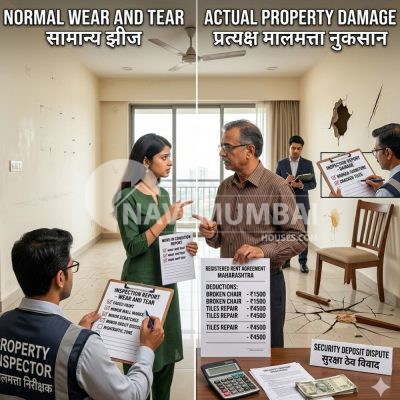
What Is Considered Normal Wear and Tear?
This is where most disputes occur.
Generally, normal wear and tear includes:
- Minor wall fading
- Small nail holes
- Natural paint deterioration
- Ordinary aging of fixtures
Therefore, landlords usually cannot charge tenants for the natural aging of the property.
For example, if a five-year-old paint job looks slightly dull after your tenancy, that is generally expected.
However, large wall stains, structural damage, or deliberate destruction are entirely different matters.
Real-Life Scenario: A Common Deposit Dispute
Let’s say you rent a flat in Navi Mumbai for two years.
You paid:
- Rent: ₹30,000 per month
- Deposit: ₹1,20,000
Before vacating:
- All rent paid
- Electricity bills cleared
- Society dues settled
However, the landlord later claims ₹50,000 for repainting the entire apartment.
If the agreement does not specifically permit such deductions and the paint deterioration falls under normal wear and tear, the claim may be difficult to justify.
Therefore, move-in and move-out documentation becomes extremely important.
How Tenants Can Protect Their Security Deposit
1. Take Photos Before Moving In
First, create a detailed record of:
- Walls
- Flooring
- Furniture
- Appliances
- Bathrooms
- Balconies
As a result, you will have strong evidence if disputes arise later.
2. Record Existing Damage
Furthermore, don’t rely solely on verbal conversations.
Instead, email or message the landlord listing any existing issues.
Examples include:
- Scratches
- Leakage
- Broken handles
- Stains
3. Keep Payment Records
Similarly, maintain proof of:
- Deposit transfer
- Rent payments
- Utility payments
Digital records eliminate confusion and strengthen your position.
4. Read Every Clause Carefully
Moreover, never sign a rental agreement without understanding:
- Deposit refund terms
- Deduction conditions
- Exit requirements
5. Request a Joint Inspection
Finally, before vacating, conduct a property inspection with the landlord.
As a result, both parties can agree on the property’s condition before handover.
Proper documentation is one of the most effective ways to safeguard your Maharashtra rental deposit and prevent unnecessary disputes at the end of the tenancy.
Additionally, tenants should verify ownership details and property records whenever possible. Information related to property registration and legal documentation can be accessed through the Maharashtra Inspector General of Registration Portal.
How Long Should It Take to Receive Your Deposit Back?
The timeline varies depending on the agreement.
Many landlords return deposits within:
- 7 days
- 15 days
- 30 days after possession handover
Therefore, a professionally drafted agreement should clearly define this period.
Otherwise, misunderstandings become much more likely.
Red Flags Every Tenant Should Watch For
Certain warning signs should immediately raise concerns.
No Written Agreement
First and foremost, never rely solely on verbal promises.
Cash-Only Deposits
Instead, use bank transfers whenever possible because they create an official payment trail.
Vague Deduction Clauses
Likewise, avoid agreements that give unrestricted deduction powers.
Refusal to Register the Agreement
Furthermore, registration adds legal credibility and protection.
Unusually High Deposits
Finally, ask why the amount exceeds local market norms.
After all, transparency is always a positive sign.
If a landlord refuses to clearly explain the Maharashtra rental deposit terms, tenants should proceed with caution and seek clarification before signing any agreement.
The Emotional Side of Security Deposits
For many renters, the security deposit represents months of savings.
It may have come from:
- A relocation budget
- Emergency funds
- Family support
- Years of disciplined saving
Therefore, losing part of that amount due to preventable misunderstandings can create significant financial stress.
That’s why smart tenants treat deposit protection with the same seriousness as choosing the right flat.
After all, the goal isn’t merely securing a roof over your head.
More importantly, it’s about protecting your financial stability.
Common Myths About Security Deposits
Myth 1: The Landlord Can Keep the Deposit for Any Reason
False.
In reality, deductions should generally be supported by valid reasons and agreement terms.
Myth 2: Verbal Agreements Are Enough
False.
Instead, written and documented agreements carry far greater weight.
Myth 3: Deposits Are Non-Refundable
False.
Generally, security deposits are refundable after legitimate adjustments.
Myth 4: Photos Are Unnecessary
False.
In fact, photographs often become the strongest evidence during disputes.

Final Thoughts: Knowledge Is Your Best Protection
The rental market in Maharashtra continues to evolve. Nevertheless, one reality remains unchanged: informed tenants face fewer disputes and enjoy smoother rental experiences.
Before paying any security deposit:
- Read the agreement carefully.
- Additionally, document the property’s condition.
- Understand deduction rules.
- Keep all payment records.
- Clarify refund timelines.
The smartest renters aren’t necessarily the ones who find the cheapest apartment.
Rather, they are the ones who understand their rights and responsibilities before signing the agreement.
Ultimately, knowledge is your strongest protection. By taking a few precautions today, you can avoid costly disputes tomorrow and ensure that your security deposit comes back to you with minimal complications.
Whether you’re renting your first apartment in Navi Mumbai or relocating within Maharashtra, understanding these security deposit rules can protect both your finances and your peace of mind.
Ultimately, understanding Maharashtra rental deposit rules can save tenants from financial losses, legal complications, and stressful disputes when moving out.
For the latest updates on housing policies, rental regulations, and consumer rights, renters can also refer to the Ministry of Housing and Urban Affairs, which regularly publishes housing-related notifications and guidelines.
The post Maharashtra Rental Deposit Rules: Tenant Guide 2026 appeared first on .