


Navi Mumbai property budget is an important consideration for anyone earning ₹40,000 a month and planning to buy their first home.
Buying property in Navi Mumbai on a ₹40,000 salary may seem difficult. However, with careful budgeting, a realistic down payment and the right locality, first-time buyers can create a practical path toward homeownership.
Earning ₹40,000 a month and dreaming of owning a home in Navi Mumbai? For many first-time buyers, that dream can feel difficult. Property prices have increased, Mumbai remains expensive, and, at the same time, a home loan can feel like a major financial responsibility.
However, buying a home on a ₹40,000 salary is not necessarily impossible. Instead, it requires careful planning, realistic expectations and the right location strategy.
You may not be able to buy a large 2 BHK in every Navi Mumbai locality. Nevertheless, by choosing an affordable property, building a strong down payment and keeping your EMI under control, you can create a realistic path toward homeownership.
Navi Mumbai continues to attract budget-conscious buyers because locations such as Taloja, Panvel and parts of Ulwe offer relatively accessible housing options. Moreover, ongoing infrastructure development is strengthening the long-term appeal of several developing areas.
So, how should someone earning ₹40,000 per month actually plan to buy a home?
Let’s break it down.
Before paying a booking amount, check the project’s RERA registration and available disclosures on the official MahaRERA
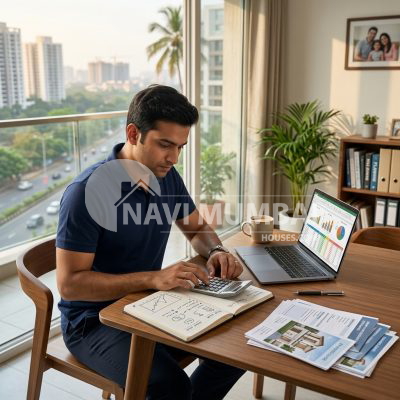
Can You Buy Property in Navi Mumbai on ₹40,000 Salary?
Therefore, your Navi Mumbai property budget should be based on your actual monthly income, expenses, savings and existing financial commitments.
Yes, you can potentially buy a home in Navi Mumbai on a ₹40,000 salary. However, your property budget must be based on what you can comfortably afford rather than the maximum loan a bank may offer.
This distinction is extremely important.
Banks generally consider factors such as your income, existing liabilities, credit history and repayment capacity while evaluating a home loan. Nevertheless, your personal affordability also depends on everyday expenses, family responsibilities, insurance, transportation and emergency savings.
Therefore, instead of asking, “How much home loan can I get?”, ask:
“How much EMI can I comfortably pay every month without damaging my finances?”
For someone earning ₹40,000, keeping the EMI manageable is essential. Depending on your existing expenses and financial commitments, a lower EMI could provide considerably more breathing room.
After all, becoming a homeowner should improve your financial security rather than create constant financial pressure.
Step 1: Calculate Your Real Monthly Budget
Before you start visiting properties, first understand where your salary is going.
For example, a ₹40,000 monthly income could be planned approximately like this:
| Monthly Income | ₹40,000 |
|---|---|
| Essential household expenses | ₹18,000 |
| Transport and personal expenses | ₹5,000 |
| Insurance/emergency allocation | ₹3,000 |
| Home-buying savings | ₹8,000 |
| Flexible monthly buffer | ₹6,000 |
This is only an example. Therefore, you should create a budget based on your actual expenses.
Most importantly, identify how much you can consistently save every month.
If you can save ₹8,000 to ₹10,000 every month, that amount can gradually become your home-buying fund. Additionally, salary increments, bonuses and other legitimate savings can accelerate the process.
So, don’t begin with:
“Which flat can I buy?”
Instead, begin with:
“How much can I comfortably save and pay every month?”
That answer will help determine your realistic property budget.
Step 2: Build Your Down Payment
A well-planned Navi Mumbai property budget should include not only the down payment but also registration, taxes, documentation and emergency savings.
Once your monthly budget is clear, the next priority should be your down payment.
A home loan generally does not cover every expense involved in buying a property. Therefore, you need to prepare separately for the down payment as well as other purchase-related costs.
These may include:
- Down payment
- Stamp duty
- Registration charges
- Legal and documentation expenses
- Maintenance deposits
- Parking charges, where applicable
- Brokerage, where applicable
- Basic interiors
- Moving expenses
- Emergency savings
For example, the uploaded affordable-housing research uses a ₹50 lakh property as an illustration, where approximately ₹10 lakh could be required as a down payment. However, the actual requirement will vary depending on the property, loan structure and applicable charges.
Therefore, don’t rush into buying immediately after finding a property that looks affordable.
Instead, create a separate home-buying fund.
If you save ₹10,000 every month:
-
If you save ₹10,000 every month:
- In the first year, your savings could reach ₹1.2 lakh.
- Over three years, the same monthly saving could build a corpus of ₹3.6 lakh.
- By the fifth year, you could accumulate around ₹6 lakh.
Furthermore, whenever your income increases, consider directing a portion of the additional income toward your property fund.
The bigger your down payment, the smaller your loan requirement can become. Consequently, your EMI may also become more manageable.
Step 3: Choose the Right Navi Mumbai Location
Your Navi Mumbai property budget will also determine which localities and property configurations you can realistically consider.
When you earn ₹40,000 per month, location selection becomes particularly important.
You may not be able to comfortably target every established or premium locality. Therefore, instead of focusing only on popular areas, explore locations where the entry price is comparatively accessible and infrastructure is improving.
Taloja
Taloja is particularly relevant for budget-conscious buyers. The uploaded research identifies Taloja among the locations where buyers actively search for affordable homes, including low-budget 1 BHK properties.
Therefore, a compact 1 BHK or suitable smaller home in Taloja could be more realistic for a first-time buyer earning ₹40,000 than a larger property in a premium locality.
At the same time, buyers should evaluate the exact project, connectivity, amenities and surrounding development rather than judging the entire locality only by its price.
Panvel
Panvel is another important market for budget-conscious buyers.
Moreover, the wider Panvel region benefits from highway connectivity and major infrastructure development. The area has also attracted attention because of the broader development surrounding Navi Mumbai International Airport.
Consequently, buyers willing to trade some centrality for affordability may find more options here.
Ulwe
Ulwe has gained considerable attention because of infrastructure development around Navi Mumbai International Airport.
However, buyers should not purchase a property simply because it is marketed as being close to an airport corridor.
Instead, check the exact distance from major roads and transport links, the surrounding development, social infrastructure and the project’s overall credentials.
Kharghar
Kharghar is an established residential destination with strong social infrastructure and connectivity.
However, property prices can vary significantly between sectors and projects. Therefore, someone earning ₹40,000 should focus on specific affordable opportunities instead of assuming that every property in Kharghar will fit the budget.
Ultimately, the objective is not to buy the cheapest property.
The objective is to buy the most sensible property you can afford in a location that supports your lifestyle and long-term plans.
Step 4: Consider a 1 BHK Before a 2 BHK
Your first home does not necessarily have to be your forever home.
In fact, this mindset can significantly improve your buying strategy.
For someone earning ₹40,000, a compact 1 BHK may be more financially comfortable than stretching for a 2 BHK with a large EMI.
A smaller property can offer several advantages:
- Lower purchase price
- Lower down payment requirement
- Smaller loan
- Lower EMI
- Lower maintenance expenses
- Potential rental demand in suitable locations
- Easier affordability for a first-time buyer
The uploaded affordable-housing research indicates that properties below ₹50 lakh in Navi Mumbai are generally concentrated in smaller configurations and outer or developing nodes, including 1 RK and 1 BHK options.
Therefore, buying a smaller home first can be a sensible financial stepping stone.
Later, as your income increases and your financial position improves, you can consider upgrading.
Step 5: Keep Your Home Loan EMI Under Control
Most importantly, your Navi Mumbai property budget should keep the monthly EMI at a level that you can comfortably manage.
This is arguably the most important part of your entire home-buying plan.
Suppose you purchase a ₹50 lakh property and arrange approximately ₹10 lakh as a down payment. You could then require a loan of around ₹40 lakh before considering additional purchase costs.
However, the monthly EMI on such a loan may be too high for someone earning ₹40,000.
For illustration, the uploaded research discusses a ₹36 lakh loan over 15 years with an approximate EMI in the ₹30,000–₹35,000 range, depending on the interest rate.
For a ₹40,000 salary earner, an EMI at that level could consume most of the monthly income.
Therefore, instead of stretching to the maximum possible loan, consider these strategies:
- Increase your down payment.
- Search for a lower-priced property.
- Consider a suitable loan tenure after comparing total interest.
- Increase your household income.
- Consider an eligible co-borrower where appropriate.
- Wait for your income to improve before purchasing.
Remember, loan eligibility is not the same as financial affordability.
Step 6: Use Salary Growth to Increase Your Buying Power
Your current salary does not have to determine your property budget forever.
For example, suppose you currently earn ₹40,000 and save ₹8,000 every month. If your salary rises significantly over the next few years, you can redirect a portion of the increment toward your home-buying goal.
Instead of immediately increasing lifestyle expenses, consider using part of every salary increase for:
- Down payment savings
- Emergency funds
- Loan prepayment
- Registration and purchase costs
- Future home expenses
Consequently, your salary growth can gradually increase your purchasing power.
In other words, your first property plan should grow along with your career.
Step 7: Calculate the Complete Property Cost
Before booking a property, review your Navi Mumbai property budget again and calculate the complete purchase cost.
One common mistake first-time buyers make is focusing only on the advertised property price.
However, the final cost can include several additional expenses.
Before booking, calculate:
- Property price
- Down payment
- Stamp duty
- Registration
- Applicable GST
- Maintenance deposits
- Parking charges, if applicable
- Brokerage, if applicable
- Legal and documentation expenses
- Interior costs
- Moving expenses
For under-construction properties, applicable taxes should also be checked carefully. Similarly, ready-to-move properties may have different tax considerations depending on their status and documentation.
Therefore, never make your decision based only on the headline price.
Calculate the total acquisition cost before signing anything.
Step 8: Check RERA and the Builder
Affordability should never come at the expense of due diligence.
Before paying a booking amount, check the project’s RERA registration and available disclosures.
Additionally, investigate the developer’s track record, previous projects, and delivery history.
You should also verify:
- Land title
- Approved plans
- RERA details
- Possession timeline
- Project specifications
- Agreement for Sale
- Loan availability
- Applicable charges
The uploaded housing-project research specifically recommends checking RERA registration, developer credibility, land title, approved plans, possession details and financing before booking a property.
Furthermore, don’t rely entirely on verbal promises made during a site visit.
Ask for important commitments in writing.
Step 9: Keep an Emergency Fund
One of the biggest mistakes a first-time buyer can make is using every rupee of savings for the down payment.
Imagine buying a home and then facing an unexpected job change, medical expense, family responsibility, or major financial emergency.
Without an emergency reserve, even an apparently affordable EMI can suddenly become difficult.
Therefore, keep an emergency fund separate from your property corpus.
Your goal should be simple:
Buy the home without putting your entire financial life at risk.
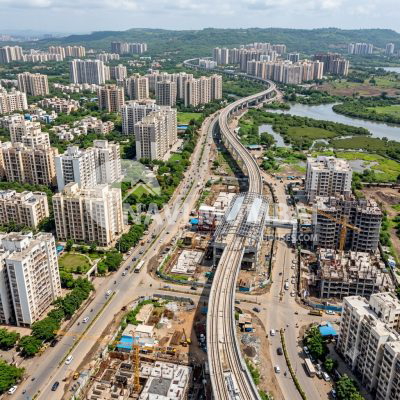
Roadmap to Buy Property in Navi Mumbai on ₹40,000 Salary
So, what could the overall strategy look like?
Phase 1: Stabilise your finances
First, control unnecessary debt and build an emergency fund.
Phase 2: Start a property fund
Next, save consistently every month for your down payment and purchase expenses.
Phase 3: Research affordable locations
Then, compare Taloja, Panvel, Ulwe and selected budget opportunities across Navi Mumbai.
Phase 4: Understand your loan eligibility
After that, compare lenders and understand the EMI you can realistically manage.
Phase 5: Shortlist suitable properties
Focus on homes that fit your actual budget rather than properties that require financial stretching.
Phase 6: Complete due diligence
Finally, verify RERA, title documents, builder history, possession details, and the total cost.
This process may take several months or even a few years.
Nevertheless, taking additional time to prepare can be far better than committing to an EMI that leaves you financially stressed for the next 15–20 years.
Additionally, before finalising a home loan, buyers should understand the applicable lending terms and compare offers carefully. For general information on housing finance and banking regulations, you can refer to the official Reserve Bank of India
What About Future Property Appreciation?
Navi Mumbai’s infrastructure story is one of the reasons buyers continue to watch the region closely.
The uploaded market research highlights major infrastructure drivers including Navi Mumbai International Airport, metro expansion, MTHL and improving road and rail connectivity. It also identifies Taloja, Panvel, Ulwe and Kharghar among areas attracting buyer and investor attention.
However, infrastructure alone does not guarantee property appreciation.
Therefore, when evaluating a property, consider:
- Connectivity
- Employment opportunities nearby
- Schools and hospitals
- Social infrastructure
- Future development
- Competing property supply
- Rental demand
- Builder reputation
- Actual purchase price
A slightly more expensive property in a better-connected micro-market can sometimes make more sense than an extremely cheap property with weak connectivity.
Price matters. However, location quality matters just as much.

Common Mistakes to Avoid
Taking the Maximum Loan
Just because a bank offers a particular loan amount does not mean you should take it.
Buying Because of a Discount
A limited-period offer cannot turn an unsuitable property into a good investment.
Ignoring Additional Costs
Always calculate the all-in cost before making your decision.
Choosing Only on Price
A low purchase price is useful only when the property also meets your location, legal and lifestyle requirements.
Using All Your Savings
Keep an emergency reserve even after paying your down payment.
Skipping Legal Checks
Always verify RERA, title, approvals, and agreement documents.
Buying for Status
Your first home should fit your finances rather than someone else’s expectations.
Final Thoughts: Can ₹40,000 Salary Buy a Home in Navi Mumbai?
Before making a final decision, review your Navi Mumbai property budget again and ensure the total purchase cost fits comfortably within your long-term financial plan.
Yes, but realistic expectations are essential.
At ₹40,000 per month, you may not comfortably afford every type of property across Navi Mumbai. Premium locations, larger apartments, and high-ticket projects may require a substantially higher income or combined household income.
Nevertheless, affordable opportunities can still exist, particularly when you consider smaller homes and developing locations.
Therefore, the smarter strategy is:
Save → Build your down payment → Control your EMI → Choose the right locality → Verify the property → Buy within your means.
Navi Mumbai’s infrastructure development and expanding residential market continue to create opportunities for long-term buyers. However, the right property is not necessarily the one promising the highest appreciation.
Instead, it is the property you can comfortably afford today while giving yourself room to grow tomorrow.
Your ₹40,000 salary does not have to be the end of your homeownership dream.
It can be the starting point.
Looking for a Property Within Your Budget?
If you are searching for affordable flats in Navi Mumbai, Panvel, Taloja, Ulwe or Kharghar, compare properties based on your actual salary, down payment capacity, preferred location and long-term goals.
At Navi Mumbai Houses, the focus should be on helping buyers find properties that match their real requirements rather than simply showing them homes outside their budget.
Start with your budget. Then find the right home

Frequently Asked Questions
Can I buy a flat in Navi Mumbai with a ₹40,000 salary?
Yes, potentially. However, your options will depend on your savings, existing liabilities, credit profile, down payment, and home-loan eligibility. Smaller homes and developing locations may be more realistic.
Which areas are suitable for budget buyers in Navi Mumbai?
Taloja and parts of Panvel are particularly relevant for budget-focused buyers. Additionally, Ulwe and selected areas of Kharghar can be considered depending on the property’s price and your overall financial capacity.
Should I buy a 1 BHK or 2 BHK?
For a ₹40,000 salary, a 1 BHK or compact home may be financially safer if a 2 BHK would require an oversized EMI. Later, you can consider upgrading as your income increases.
How much down payment should I save?
The exact amount depends on the property’s price, loan structure and applicable charges. Therefore, apart from the down payment, maintain separate funds for registration, taxes, legal expenses and emergencies.
Is Taloja good for first-time buyers?
Taloja is worth considering for budget-conscious buyers because it offers relatively affordable housing options and has benefited from improving connectivity. However, you should evaluate the specific project, developer, and micro-location before purchasing.
Is 2026 a good time to buy property in Navi Mumbai?
The uploaded research identifies 2026 as a period of strong interest because of infrastructure development, increasing demand and future growth potential. Nevertheless, buyers should prioritise affordability, location quality and due diligence instead of purchasing solely because the market is expected to rise.
Ultimately, buying property in Navi Mumbai on a ₹40,000 salary is a goal that requires patience, disciplined savings and realistic property selection.
Moreover, buyers researching Navi Mumbai’s planned development can refer to the official CIDCO website for information about the region’s development initiatives.
Visit Our Website: navimumbaihouses.com
The post Navi Mumbai Property Budget: How to Buy on a ₹40,000 Salary appeared first on .