


Buying your first home requires more than finding the right property. You also need a solid down payment fund in 18 months if you want to buy with less financial stress. With a clear savings plan, you can build this fund step by step. Moreover, an 18-month target gives you enough time to review your budget, cut extra costs, and prepare for your future home loan.
Example: A ₹60 Lakh Property
Suppose you are considering a home priced at ₹60 lakh.
If your financing arrangement requires you to contribute ₹12 lakh toward the property, that becomes your starting point.
However, you may also need money for registration, stamp duty, documentation, moving expenses, and an emergency reserve.
Consequently, your actual savings target could be considerably higher than ₹12 lakh.
The exact amount will depend on your property, loan structure, applicable charges, and financial circumstances. Therefore, confirm the latest charges before finalising your target.
Building a down payment fund in 18 months becomes easier when you divide your target into smaller monthly goals
Step 1: Calculate Your Down Payment Fund in 18 Months
Once you know your target, divide it by 18.
For example:
| Target Fund | Monthly Saving Required |
|---|---|
| ₹3.6 lakh | ₹20,000 |
| ₹5.4 lakh | ₹30,000 |
| ₹7.2 lakh | ₹40,000 |
| ₹9 lakh | ₹50,000 |
| ₹10.8 lakh | ₹60,000 |
| ₹14.4 lakh | ₹80,000 |
This calculation immediately tells you whether your target is realistic.
For example, if you need ₹9 lakh, you would need to save approximately ₹50,000 every month for 18 months.
At first, that number may look intimidating. However, you do not necessarily need to generate the entire amount from your salary.
Instead, you can combine salary savings, additional income, bonuses, expense reductions, and other legitimate sources.
The important thing is consistency.
After all, saving ₹30,000 every month for 18 months is more useful than saving ₹70,000 for three months and then stopping.
Down Payment Fund in 18 Months: Your Step-by-Step Plan
The following steps can help you create a down payment fund in 18 months without putting too much pressure on your monthly budget.
Now, let’s break the goal into smaller stages.
As a result, the target becomes easier to track and manage.
Months 1–3: Build the Foundation
First, track where your money is going.
For the first three months, carefully review:
- Rent
- Food
- Travel
- Shopping
- Entertainment
- Subscriptions
- Credit-card spending
- Existing EMIs
- Weekend expenses
Then, create a separate account or financial bucket for your home purchase.
Most importantly, automate your monthly transfer immediately after receiving your salary.
For example, if your monthly target is ₹25,000, transfer that amount first.
After that, use the remaining money for your regular expenses.
This simple approach is often more effective than saving whatever happens to remain at the end of the month.
Your home loan amount also depends on the lender’s rules and your repayment capacity. Therefore, it is useful to understand the basic housing-loan guidelines before setting your target. You can refer to the Reserve Bank of India’s housing loan guidance
Months 4–6: Reduce Your Biggest Expenses
By month four, you should have a clearer picture of your spending habits.
Therefore, this is the right time to target your three biggest unnecessary expenses.
For example, you may discover that transport, dining out, and discretionary shopping are consuming a large portion of your income.
Instead of cutting everything, focus on the expenses that can create meaningful savings.
For instance, saving ₹2,000 through subscriptions is useful. However, reducing a larger recurring expense by ₹7,000 or ₹8,000 can accelerate your home fund considerably.
Moreover, the objective is not to make your lifestyle uncomfortable forever.
Rather, you are creating an 18-month financial sprint with a specific goal at the end.
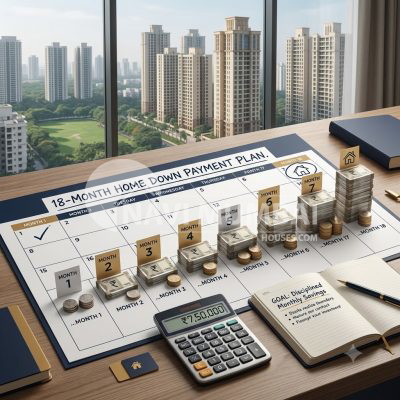
Months 7–9: Add an Extra Income Stream
At this stage, look for ways to increase the amount going into your home fund.
For example, you could allocate part of:
- Performance bonuses
- Freelance income
- Incentives
- Commissions
- Tax refunds
- Other legitimate additional income
toward the down payment.
Furthermore, you can establish a simple rule:
Regular salary → planned monthly savings
Additional income → majority allocated toward the home fund
For example, if you receive a ₹50,000 bonus, you do not have to spend it simply because it arrived.
Instead, if buying a home is your priority, directing most of that bonus toward your target can significantly shorten the distance to your goal.
Months 10–12: Start Researching Navi Mumbai Properties
You should not wait until month 18 before researching the property market.
Instead, begin understanding your options around month 10.
Start comparing areas such as:
- Panvel
- Kharghar
- Taloja
- Ulwe
- Dronagiri
- Kalamboli
- New Panvel
However, do not focus only on the headline property price.
Also compare connectivity, infrastructure, daily commute, amenities, project quality, maintenance costs, and future resale potential.
The uploaded Navi Mumbai housing material, for example, highlights budget-oriented housing options in locations such as Taloja across different 1BHK and 2BHK price ranges.
Therefore, researching actual market options can help you connect your savings target with a realistic property budget.
If you are still comparing locations and budgets, our guide to buying property in Navi Mumbai in 2026 can help you understand the current market before making a decision.
Once you shortlist a project, however, don’t rely only on the builder’s brochure. Check the project’s registration and available details on the official MahaRERA website before making a booking. The portal allows homebuyers to search registered projects and access project information.
Months 13–15: Test Your Future EMI
This is one of the most useful steps in your 18-month plan.
Before taking a home loan, start paying a practice EMI.
Suppose you estimate that your future home-loan EMI could be ₹30,000 per month.
Then, for the next three months, set aside ₹30,000 as though the EMI has already started.
As a result, you accomplish two things at once.
First, you test whether the EMI comfortably fits your monthly budget.
Second, you continue building your savings.
If the practice EMI feels difficult, do not ignore that warning.
Instead, reconsider your property budget, loan amount, or purchase timeline before making a commitment.
Testing your future EMI can make your down payment fund in 18 months more practical because you learn how much money you can comfortably set aside.
Before choosing a loan, read our Navi Mumbai home loan and EMI guide to understand loan eligibility, EMI planning, and common financing mistakes.
Months 16–18: Protect Your Savings
By the final three months, your home fund should be treated differently.
At this point, the money has a specific purpose.
Therefore, avoid unnecessary withdrawals and avoid taking excessive investment risks with money you expect to use soon.
At the same time, start preparing your property and loan documents.
These may include:
- Identity proof
- Address proof
- Salary slips
- Bank statements
- Income-tax documents
- Employment records
- Existing loan details
Furthermore, compare home-loan offers carefully instead of choosing the first lender you approach.
Your monthly savings target is the most important number when building a down payment fund in 18 months.
Don’t Use Your Entire Savings for the Down Payment
This is one of the most important rules for first-time buyers.
You should not become financially vulnerable simply because you finally reached your down payment target.
Imagine saving ₹10 lakh and using every rupee for your purchase.
Then, two months later, an unexpected medical, family, employment, or vehicle-related expense appears.
Without an emergency reserve, you may have to rely on expensive credit.
Consequently, the financial pressure of owning the home can become greater than expected.
Therefore, maintain a separate emergency fund alongside your home-purchase fund.
The ideal amount depends on your income, dependants, job stability, existing obligations, and overall financial position.
Organise Your Home Down Payment Savings
A simple three-bucket system can make your 18-month plan easier.
Bucket 1: Monthly Expenses
This bucket covers your normal lifestyle.
For example, it can include rent, food, transportation, utilities, and regular commitments.
Bucket 2: Emergency Fund
This money exists for genuine emergencies.
Therefore, do not use it for holidays, gadgets, furniture, or other discretionary purchases.
Bucket 3: Home Purchase Fund
This is your dedicated property fund.
Once money enters this bucket, treat it as committed.
As a result, you are less likely to spend it accidentally.

What If Your Down Payment Fund Falls Short?
Don’t panic if the numbers do not work immediately.
Instead, consider the following options.
Option 1: Reduce Your Property Budget
A lower property price can reduce both your upfront contribution and your future EMI.
Therefore, choosing the right locality can make a significant difference.
Option 2: Increase Your Monthly Savings
Even an additional ₹5,000 per month adds ₹90,000 over 18 months.
Similarly, an additional ₹10,000 per month adds ₹1.8 lakh.
Consequently, a relatively small monthly adjustment can create a meaningful difference over time.
Option 3: Consider Genuine Family Support
Some first-time buyers receive financial assistance from parents or other family members.
If you choose this route, document the arrangement properly and understand the relevant banking and tax implications.
Option 4: Extend the Timeline
Finally, remember that 18 months is a target, not a law.
If the numbers are uncomfortable, extending the timeline by six months may be much wiser than taking an unaffordable loan.
After all, the goal is not merely to buy a house.
The goal is to buy a house without destroying your financial stability.
Don’t Forget Stamp Duty and Registration
Your savings plan should include transaction costs from the beginning.
In Maharashtra, the Registration & Stamps Department handles property registration and stamp-duty-related functions.
Therefore, check the latest applicable charges before finalising your purchase budget.
Similarly, verify project details and registration information through the appropriate official channels before committing to a property.
In addition, remember that charges and regulations can change.
Consequently, always verify the current figures rather than relying on an old calculator, article, or social-media post.
A Simple ₹9 Lakh Example
Let’s assume your target is to build a ₹9 lakh home purchase fund in 18 months.
Your basic calculation would be:
₹9,00,000 ÷ 18 = ₹50,000 per month
At first, ₹50,000 may appear difficult.
However, you could potentially combine different sources.
For example:
- Salary savings: ₹35,000/month
- Additional income: ₹5,000/month
- Average bonus allocation: ₹5,000/month
- Expense reduction: ₹5,000/month
That gives you:
₹50,000 × 18 months = ₹9 lakh
Therefore, the entire target does not necessarily have to come from one source.
Instead, several controlled financial decisions can work together.

Avoid These Home Down Payment Savings Mistakes
Saving Without a Property Budget
Do not save a random amount without knowing what you want to buy.
Instead, connect your savings target to a realistic property price.
Ignoring Existing EMIs
Your future home loan will be added to your existing financial commitments.
Therefore, calculate your total monthly obligations before deciding how much you can borrow.
Using Credit Cards to Maintain Your Lifestyle
High-interest debt can quickly undo months of disciplined saving.
As a result, avoid using credit to maintain spending habits that your income cannot comfortably support.
Taking Excessive Investment Risk
Your down payment has a relatively short timeline.
Therefore, prioritise liquidity and capital preservation over chasing aggressive returns.
Spending Your Bonus Before It Arrives
Expected income is not the same as received income.
Consequently, build your plan around money you can reasonably depend on.
Forgetting Purchase Costs
Finally, remember that the down payment is only one part of the overall purchase requirement.
Avoiding these mistakes can help you protect your down payment fund in 18 months.
For more guidance, read our guide on 10 costly mistakes first-time buyers should avoid in Navi Mumbai before booking a property.
Why Your Down Payment Fund in 18 Months Matters
Watching your home fund grow feels good.
At first, saving ₹1 lakh may seem hard. However, small steps can add up fast.
Save a fixed amount each month. Keep doing it. Soon, you will see real progress.
By month 12, you will know your budget better. You will also know how much more you need to save.
Then comes month 18.
At this point, your home is no longer just a dream. You have money set aside for it.
You are also better prepared to start your property search.
A clear budget makes home hunting easier. You can compare areas with less stress. You can also compare homes based on your needs.
If a home costs too much, walk away. There is no need to take on a loan that feels too heavy.
Good savings also give you more room to negotiate. You can take your time and make a better choice.
Most importantly, you can buy with confidence.
You are not rushing because you found the first home you liked. Instead, you are choosing a home that fits your budget and your plans.
That is the real value of an 18-month savings plan.
Your 18-Month Down Payment Checklist
Before starting your plan, write down these seven numbers:
- Target property price
- Expected down payment
- Stamp duty and registration budget
- Other purchase costs
- Emergency fund target
- Monthly savings capacity
- Expected future EMI
Then calculate the amount you need to save every month.
If the number is manageable, start immediately.
However, if the number is unrealistic, do not force the plan.
Instead, reduce the property budget, increase your savings capacity, or extend the timeline.

Final Thoughts
For a first-time buyer in Navi Mumbai, the smartest property purchase often begins long before the first site visit.
It begins with financial preparation.
Therefore, use the next 18 months deliberately.
Save automatically. Reduce unnecessary expenses. Increase your income where possible. Research suitable localities. Test your future EMI. Finally, protect your emergency fund.
Most importantly, remember this:
You don’t need to become wealthy overnight to buy your first home. You need a realistic target, disciplined habits, and enough time to execute the plan.
If you are planning to buy in Navi Mumbai within the next 18 months, start researching properties that fit your expected budget today.
Because when the right property appears, being financially ready can be the difference between watching an opportunity pass and confidently saying, “Let’s take the next step.”
Most importantly, a down payment fund in 18 months gives you a clear financial target instead of leaving your home-buying goal uncertain.
The post Down Payment Fund in 18 Months: First-Time Buyer Plan appeared first on .