
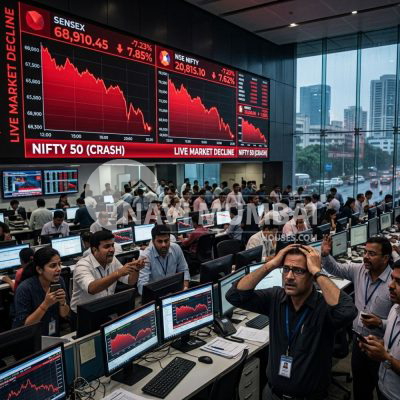
Last week wasn’t just another rough patch for the stock market. It was a sharp reminder of how quickly wealth can evaporate when uncertainty grips investor sentiment.
India’s top listed companies collectively lost a staggering ₹3.12 lakh crore in market valuation in just five trading sessions. That’s not merely a headline number. It reflects nervous investors, shifting global cues, profit booking, and a deeper concern about where the economy is heading next.
For retail investors, business owners, and even real estate buyers, moments like these create confusion. Some pantop-indian-firms-lose-3-12-lakh-crore-market-valuationic. Others freeze. But seasoned wealth creators know something important:
Every market correction carries a hidden message – and often, a hidden opportunity.
The real question is not whether markets fell.
The real question is: What should smart investors do now?
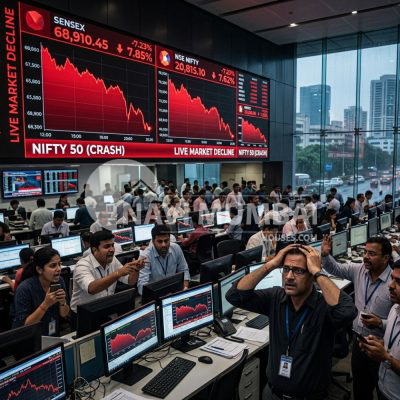
Why Did Indian Markets Lose So Much Value So Quickly?
The selloff was broad-based. Major sectors including banking, IT, energy, and financial services saw heavy erosion in valuation. Some of India’s biggest corporate giants witnessed significant declines as foreign institutional investors pulled money out amid global uncertainty.
Several factors triggered the fall:
1. Global Economic Pressure
Global markets remain volatile due to:
- Rising geopolitical tensions
- Concerns around slowing global growth
- High interest rates in Western economies
- Fear of recession in major markets
When uncertainty rises globally, emerging markets like India often face sudden capital outflows.
2. Profit Booking After Strong Rally
Indian markets had witnessed a powerful rally over the past months. Many stocks were trading at premium valuations.
Large investors and institutions used this phase to lock in profits.
This is common in mature markets. But for retail investors, sudden corrections feel emotionally overwhelming because they often enter near market highs.
3. FIIs Turning Cautious
Foreign Institutional Investors (FIIs) play a massive role in Indian market movements.
When FIIs sell aggressively:
- Liquidity tightens
- Market confidence weakens
- Valuations compress rapidly
Even fundamentally strong companies can see sharp corrections during such phases.
Which Sectors Were Hit the Hardest?
Some of the biggest losses came from:
- Banking & Financial Services
- IT Companies
- Energy Giants
- FMCG Leaders
- Infrastructure-linked firms
Large-cap companies generally absorb the first wave of institutional selling because they offer high liquidity.
Ironically, these are often the same companies long-term investors rush back into once the panic settles.
What This Means for Retail Investors
Here’s the uncomfortable truth:
Most retail investors lose money not because markets crash – but because emotions take control.
When headlines scream “₹3.12 lakh crore wiped out,” fear spreads instantly.
People start:
- Selling quality assets in panic
- Delaying investments
- Moving entirely to cash
- Avoiding opportunities created by corrections
But history repeatedly shows that India’s strongest wealth creation phases often begin during periods of uncertainty.

Smart Investors Think Differently During Corrections
Experienced investors don’t merely ask:
“Why is the market falling?”
They ask:
“Which quality assets are becoming cheaper?”
That mindset shift changes everything.
Market corrections:
- Reset inflated valuations
- Create better entry points
- Separate strong companies from weak ones
- Reward patient capital
India’s long-term growth story remains intact due to:
- Rapid urbanization
- Infrastructure expansion
- Rising middle-class consumption
- Manufacturing growth
- Digital transformation
Short-term volatility doesn’t erase long-term economic momentum.
Why Real Estate Investors Should Pay Attention
Many people think stock market corrections only affect equity investors.
That’s a mistake.
Stock market sentiment strongly influences:
- Luxury housing demand
- Commercial leasing confidence
- Investor psychology
- Liquidity movement
- High-ticket purchases
When equity markets turn volatile, many investors begin reallocating capital toward more stable, tangible assets like real estate.
And this trend becomes especially visible in cities like:
- Mumbai
- Navi Mumbai
- Bengaluru
- Pune
- Gurgaon
- Hyderabad
Real Estate Often Becomes a “Safety Asset”
Unlike stocks, real estate offers:
- Physical ownership
- Rental income
- Long-term appreciation
- Inflation protection
- Emotional security
This is why many HNIs and seasoned investors diversify into premium property during volatile equity phases.
Especially in infrastructure-driven micro-markets, smart property investments continue compounding quietly even when markets fluctuate daily.
Navi Mumbai Is Quietly Becoming a Strategic Investment Hub
While stock market volatility dominates headlines, infrastructure-led growth in regions like Navi Mumbai continues aggressively.
Key growth drivers include:
- Navi Mumbai International Airport
- Metro connectivity expansion
- Coastal road development
- Corporate expansion
- Increasing commercial activity
This is creating long-term demand for:
- Residential projects
- Rental housing
- Premium apartments
- Commercial office spaces
And unlike speculative stock trades, real estate in emerging corridors builds wealth gradually with lower day-to-day emotional volatility.
The Psychology of Wealth Preservation Is Changing
Today’s investors are no longer chasing only fast profits.
After witnessing repeated market swings, many people now prioritize:
- Stability
- Asset-backed investments
- Predictable appreciation
- Rental cash flow
- Long-term wealth preservation
This is precisely why premium real estate demand has remained surprisingly resilient despite economic uncertainty.
People want assets they can see, use, leverage, and pass on.
That emotional factor matters more than most analysts admit.
Should Investors Panic Right Now?
No. But they should become more strategic.
Market corrections are dangerous only when investors:
- Overleverage themselves
- Follow herd mentality
- Invest emotionally
- Ignore fundamentals
Instead, this phase demands:
- Portfolio review
- Risk balancing
- Asset diversification
- Long-term thinking
This is where genuine financial and real estate advisors become crucial.
Because during uncertain times, bad advice becomes extremely expensive.
The Biggest Mistake Investors Make During Market Fear
Many investors wait endlessly for the “perfect time.”
But perfect timing rarely exists.
The wealthiest investors typically build assets during periods when:
- Sentiment is weak
- Confidence is low
- Fear dominates headlines
By the time optimism returns, prices usually move much higher.
That applies to:
- Stocks
- Real estate
- Commercial assets
- Land investments
Fear creates hesitation.
Hesitation often delays wealth creation.
What Happens Next for Indian Markets?
Short-term volatility may continue.
Global cues remain uncertain, and markets could remain sensitive to:
- Interest rate decisions
- Oil prices
- Foreign fund flows
- Corporate earnings
- Election-linked sentiment
However, India’s structural growth story still appears stronger than many global economies.
The country continues benefiting from:
- Infrastructure spending
- Manufacturing push
- Startup ecosystem growth
- Expanding urban demand
- Rising disposable income
Which means corrections may create opportunities rather than permanent damage.
How Smart Investors Are Positioning Themselves Now
Seasoned investors are focusing on:
Diversification
Balancing equities with real estate, debt instruments, and safer long-term assets.
Infrastructure-Led Property Markets
Micro-markets connected to airports, metros, and commercial hubs are attracting strong attention.
Quality Over Hype
Investing in fundamentally strong companies and trustworthy real estate developers.
Long-Term Wealth Creation
Ignoring short-term noise and focusing on 5–10 year appreciation cycles.
![Long-term wealth creation through smart investing in India]](https://cdn.navimumbaihouses.com/blog/wp-content/uploads/2026/05/Long-term-wealth-creation-through-smart-investing-in-India-400x400.jpg)
Final Thoughts
The ₹3.12 lakh crore erosion in market valuation is undoubtedly significant. But moments like these also reveal how fragile emotional investing can be.
Wealth is rarely built during periods of comfort.
It is built when investors stay rational while others panic.
India’s economy is evolving rapidly. Infrastructure is transforming cities. New investment corridors are emerging. Asset classes are shifting. Consumer aspirations are rising.
And amid all this uncertainty, one truth remains consistent:
Smart investors don’t merely react to headlines – they position themselves ahead of the next growth cycle.
Whether it’s equities, commercial investments, or high-potential real estate markets, the coming years will likely reward those who focus on fundamentals instead of fear.
The opportunity may not look obvious today.
But many of the biggest fortunes are built precisely in moments when the market feels the most uncertain.
The post Top Indian Firms Lose ₹3.12 Lakh Crore in Market Valuation Last Week appeared first on .